
- 17 Aug 2024
- Video Tutorial
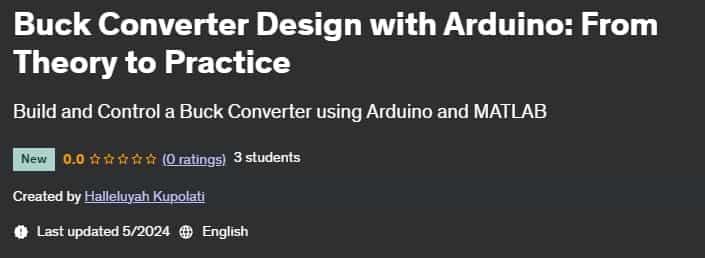
- Buck Converter Design with Arduino: From Theory to Practice, Buck Converter Design with Arduino: From Theory to Practice download, Buck Converter Design with Arduino: From Theory to Practice free, Buck Converter Design with Arduino: From Theory to Practice free download, download Buck Converter Design with Arduino: From Theory to Practice, free Buck Converter Design with Arduino: From Theory to Practice, free download Buck Converter Design with Arduino: From Theory to Practice, Halleluyah Kupolati, Udemy Buck Converter Design with Arduino: From Theory to Practice
Description
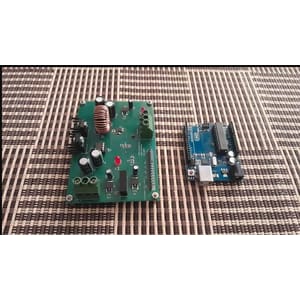
Buck Converter Design with Arduino: From Theory to Practice, Unlock the world of power electronics with this in-depth course on buck converter design and implementation using Arduino. This course is ideal for engineering students, hobbyists, and professionals eager to master buck converters from theoretical foundations to practical applications. You will begin by exploring the core principles and equations essential to designing a buck converter. You’ll then be guided through implementing Voltage Mode Control using the hysteresis method within the Arduino IDE, ensuring you understand both the theory and practical application.
A key feature of this course is the design and implementation of a PI controller using MATLAB. You will learn how to generate digital controller coefficients and integrate them into your Arduino firmware. Through clear explanations and practical examples, you’ll develop the skills to implement and optimize the PI controller for peak performance of your buck converter. The curriculum is crafted to be both accessible and challenging, catering to a diverse audience with a passion for electronics and control systems. While an Arduino Uno development board is recommended for a hands-on experience, it is not mandatory, providing flexibility for all learners. By the end of this course, you will have a comprehensive understanding of buck converter design and control. You’ll be equipped with the knowledge to apply these concepts to real-world projects and applications, making you proficient in power electronics and digital control systems.
The main objective of this course is to introduce TinyML development from data collection, model training, testing and deployment. A low-cost Arduino nano RP2040 connect board with 265 KB RAM and 16 MB flash along with accelerometer, gyroscope, microphone, temperature sensor and built-in wireless connectivity module (WiFi+Bluetooth) is used in this course and all the examples shown here have been tested on this board.
What you’ll learn
- Implementation of Voltage Mode Control using hysteresis method.
- Development of firmware using the Arduino IDE.
- Designing a PI controller for a buck converter in MATLAB.
- Generating digital controller coefficients using MATLAB.
- Firmware implementation of the PI controller for Voltage Mode Control in Arduino IDE.
Who this course is for
- Engineering students and electronics enthusiasts interested in power electronics.
- Hobbyists and makers looking to expand their skills in hardware and firmware development.
- Professionals seeking to enhance their knowledge in buck converter design and control.
- Anyone interested in learning about digital control systems and practical implementations using Arduino.
Specificatoin of Buck Converter Design with Arduino: From Theory to Practice
- Publisher : Udemy
- Teacher : Halleluyah Kupolati
- Language: English
- Level : Intermediate
- Number of Course : 8
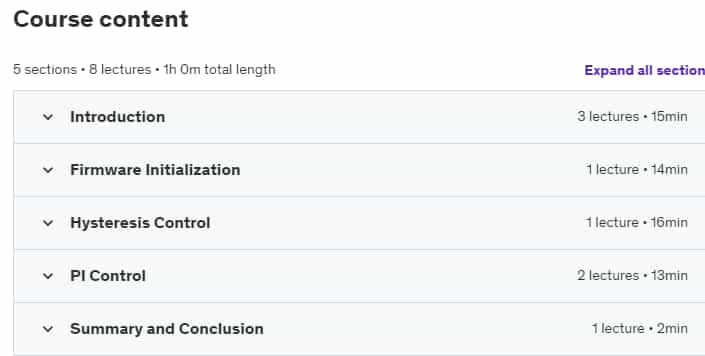
- Duration : 1 hours and 0 minutes
Content of Buck Converter Design with Arduino: From Theory to Practice
Requirements
- Basic knowledge of electronics and circuit design.
- Familiarity with the Arduino IDE and basic programming.
- Basic understanding of control systems.
- MATLAB software for designing and simulating the PI controller.
- Arduino Uno development board (recommended but not mandatory).
- Arduino IDE software.
Pictures
Download From Telegram
File size: 502 MB
How useful was this post?
Click on a star to rate it!
Average rating / 5. Vote count:
No votes so far! Be the first to rate this post.